Nature uses repeating motifs and spirals. We live in a fractal universe. Fractals are interesting from a mathematical perspective and there are a lot of really interesting websites and videos posted about them. One has only to look at patterns seen in plant structures, animal coloration patterns, cellular features, and the like to see how prevalent fractals are in nature.
This photo is of a tree fern frond that is opening. The type of pattern here is called circinate vernation (specific botanical term for fern fronds), and the spiral pattern is similar to what one sees in a carved fiddle head. Thus, fern fronds that are emerging are also know as fiddle heads. This particular tree fern is at Kirstenbosch Botanical Garden in Cape Town, South Africa.
Here are some sites to check out to learn more about fractals:
Wikipedia article about fractals
Fractal Geometry site at Yale University
17 captivating fractals found in nature
Fractal zoom video:
Showing posts with label Kirstenbosch. Show all posts
Showing posts with label Kirstenbosch. Show all posts
Monday, June 20, 2011


Friday, June 17, 2011
Time and reflection

Walking around Kirstenbosch Botanical Garden, one can come upon all sorts of interesting surprises. It had been raining the previous night, and during my morning walk of the grounds, I came across a sundial. It looked as if someone had placed the flower there as a remembrance. Perhaps it was for a photo, though. At any rate, it was too good a scene to pass by without taking a picture.
Thursday, June 16, 2011
Neon daisies

I don't know what genus and species of Asteraceae this is, but the common name should be "neon daisy." The color is so vibrant, even in partial shade. These were growing in Kirstenbosch Botanical Garden, Cape Town. I'm sure they grow wild somewhere in South Africa, but I'm not sure where.
Wednesday, June 15, 2011
Cape Canary

I spent a bit of time on the morning of October 14, 2010 watching the Cape canaries working over the flowers at Kirstenbosch Botanical Garden. The colorful backdrop combined with the bright yellow of the bird made for some interesting photographic studies. I'll post a series of images over the next several days.
Tuesday, June 14, 2011
The eyes have it

Spotted Eagle Owls were nesting in Kirstenbosch Botanical Garden during my field season last September-October. I arrived in Cape Town while the eggs were incubating. One chick hatched and gave us quite a show during the last few days of my visit to Cape Town.
Here's another view:

Monday, June 13, 2011
Kirstenbosch

Table Mountain is the major landmark of Cape Town, South Africa. I've climbed it, hiked it, photographed it from a variety of angles, and am totally smitten by this mountain. The view from Kirstenbosch Botanical Garden is of the backside of the mountain with Fernwood Buttress (shown here) the dominant rock face.
Sunday, June 12, 2011
Leucospermum

The Proteaceae has an incredible amount of diversity and some of the loveliest inflorescences amongst all flowering plants. Kirstenbosch Botanical Garden (Cape Town) has a wonderful and extensive collection of native species as well as cultivated ones.
Saturday, June 11, 2011
Dietes

Another Kirstenbosch photo. Dietes sp. (Iridaceae) from Kirstenbosch Botanical Garden, Cape Town, South Africa.
One would think that all these South Africa photos from September -October 2010 would be processed. I think it's an indication of just how busy the 2010-2011 academic year was for me. Spring Quarter 2011 just ended. I have a research quarter Autumn 2011, which should help me to catch up on everything that has piled up at school. I need to spend more time on the bench, but I especially need to find time to write up the several completed research projects from the past year. Grant proposals are also looming ahead. No teaching for awhile, but I will be pretty busy none-the-less.
Friday, June 10, 2011
A path to follow...

There are so many interesting nooks and crannies at Kirstenbosch Botanical Garden. This charming path goes up to the cycad garden. I love that you can see so many "signature" plants from South Africa in this image, including Streilitzia (bright orange flowers on left), aloes (tree-form, upper right), and plants typical of the Fynbos biome all along the path.
Thursday, June 09, 2011
"......Give me your answer, do!"

I have no idea what genus this is, but it's a lovely inflorescence of the Asteraceae. Photographed at Kirstenbosch Botanical Garden, Cape Town.
Wednesday, June 08, 2011
Namaqualand Daisies

Kirstenbosch Botanical Garden in Cape Town, South Africa has a collection of plants from around southern Africa. This display is of some of the daisies one would see in early spring in Namaqualand, the northwest corner of South Africa.
Tuesday, June 07, 2011
Watsonia

This is the color version of an image I posted a few days ago. Watsonia is a genus of Iridaceae - another of my favorites in South Africa. This was photographed at Kirstenbosch Botanical Garden.
Monday, June 06, 2011
Leucospermum

This plant has color-coding as an age indicator. The yellow flowers are the young ones, and the red have already been pollinated.
Leucospermum is one of the many genera of Proteaceae typical of the Fynbos biome in South Africa.
Sunday, June 05, 2011
Dietes

I absolutely adore the flowers of genera in the Iridaceae. I don't know the species of Dietes represented here, but it grows with wild abandon along the shady trails at Kirstenbosch Botanical Garden in Cape Town.
Saturday, June 04, 2011
Fibonacci Study

The Fibonacci series starts 0, 1, 1, 2, 3, 5, 8, 13, 21, 34, 55, 89, 144, . . .
It defines the shape of a spiral when arcs are drawn corner to corner of adjacent tiles of squares that have lengths in Fibonacci series. This spiral is abundantly found in nature and can be easily observed in plants and animals. Here's a link to the Wikepedia page that explains the series: Fibonacci number.
Friday, June 03, 2011
Leucospermum

The Proteaceae have an amazing variety of beautiful genera, but I'm particularly intrigued by the various species of Leucospermum The inflorescence of this genus reminds me of fireworks exploding in a dark sky. This one was photographed at Kirstenbosch Botanical Garden in Cape Town, South Africa on October 14, 2010.
Sunday, October 10, 2010
Orange-breasted sunbird

I posted this on Flickr yesterday morning and it made it to the Explore page - that was quite a surprise. It was from an early morning walk at Kirstenbosch with Steve. I brought along my 100-400 mm lens to try to capture some bird photos. I am becoming more and more confident with this lens. I've captured some really cool bird images with it during this field season.
Monday, October 04, 2010
Table Mountain Contour Path - Part 1
17 September, 2010 - Kirstenbosch Botanical Garden:
One of my favorite activities in Cape Town is the evening walk with the Laidlers along the Table Mountain contour path at Kirstenbosch. A gathering of friends meets in the parking lot at the upper gate of the garden, and the walk pretty much leads straight up the mountain to the contour path. The walk up to the path is through a forest, and Dennis Laidler explains the history of the Kirstenbosch forest and we discuss a bit of biogeography and ecology for the Afro-montane forests of South Africa.
This walk took place the day after I arrived, which was about 10:30 the previous night. I was pretty jet lagged, but this is a great way to get a move on toward adjusting to the new time zone. The walk is a so much fun, traversing through the Afro-montane forests on the south side of Table Mountain.
Sunday, November 05, 2006
Beautiful Pelargoniums
I have a new graduate student, Michael Broe, who will be doing his dissertation research on some aspect of the genus Pelargonium. I made arrangements with Kirstenbosch Botanical Garden via Adam Harrower to sample the garden's collection for preliminary studies. Trevor Adams is the curator of the Pelargonium collection and everything is well labeled and accessioned. We spent most of Tuesday, Oct 24, 2006, working on collecting and processing tissues and vouchers for Michael's study. I think he owes Esprit and me some dinner and a nice bottle of wine . . .
There are about 350 speces of Pelargonium - mostly in southern Africa. The morphological diversity is incredible and the genus is very complex in terms of adaptations to habitats. We were able to sample about 65 species in the collection, and I added a few extra on various excursions during my field season. Here are just a few of the ones that were flowering in the greenhouse on Oct 24.
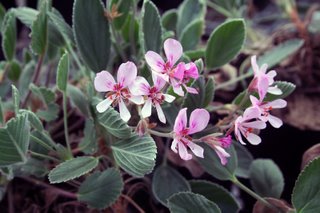
Pelargonium ovale
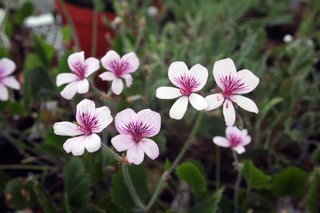
Pelargonium elegans
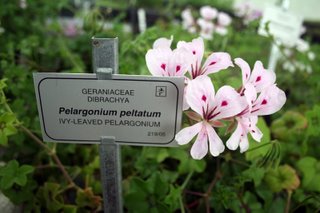
Pelargonium peltatum
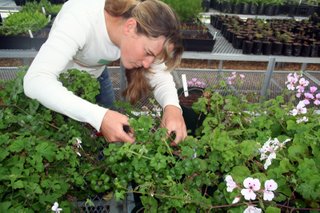
This is Monique, one of the horticulturalists in the Garden research center. Trevor was out sick on Tuesday so he asked Monique to help us. She was very helpful in sorting out the accessions, especially in tracking down stray vines and stems to not sample!
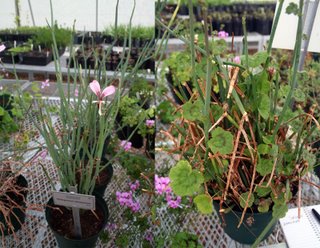
Pelargonium tetrogonum. This is an interesting plant - the leaves drop seasonally, leaving fleshy stems and the flowers.
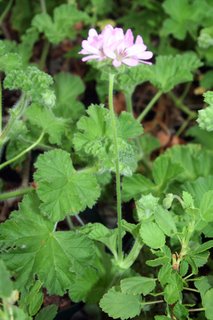
Pelargonium capitatum
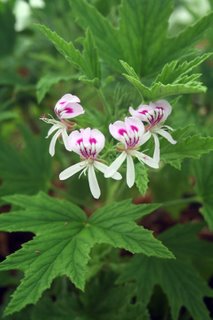
Pelargonium citronellum
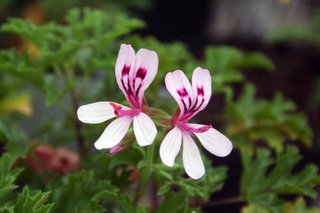
Pelargonium pseudoglutinosum
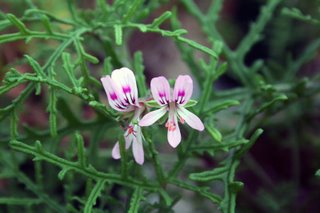
Pelargonium radens
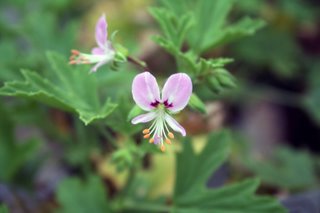
Pelargonium scabrum
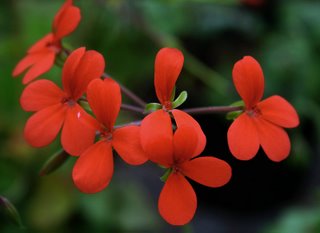
Pelargonium togaense
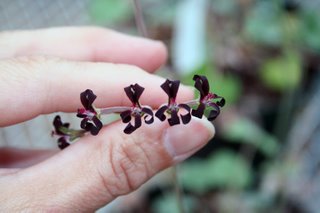
Pelargonium sidoides. This is so dark purple it appears to be black.
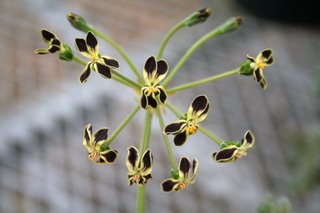
Pelargonium lobatum. The tips of these petals are black.
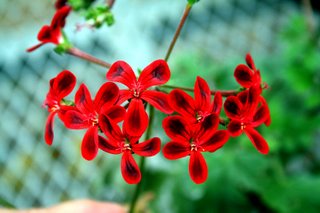
Pelargonium fulgidum X lobatum, a hybrid that has flowers so intensely red they look fluorescent.

After collecting all those samples, Esprit and I spent the next few hours in my apartment kitchen processing them for herbarium vouchers and collecting leaf material in silica gel for DNA analysis. Yes, Michael definitely owes us dinner and a nice bottle of wine.
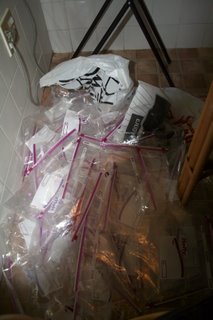
Here's the mess left over after doing all the processing.
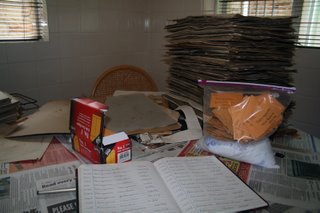
All-in-all, a good day's work.
There are about 350 speces of Pelargonium - mostly in southern Africa. The morphological diversity is incredible and the genus is very complex in terms of adaptations to habitats. We were able to sample about 65 species in the collection, and I added a few extra on various excursions during my field season. Here are just a few of the ones that were flowering in the greenhouse on Oct 24.

Pelargonium ovale

Pelargonium elegans

Pelargonium peltatum

This is Monique, one of the horticulturalists in the Garden research center. Trevor was out sick on Tuesday so he asked Monique to help us. She was very helpful in sorting out the accessions, especially in tracking down stray vines and stems to not sample!

Pelargonium tetrogonum. This is an interesting plant - the leaves drop seasonally, leaving fleshy stems and the flowers.

Pelargonium capitatum

Pelargonium citronellum

Pelargonium pseudoglutinosum

Pelargonium radens

Pelargonium scabrum

Pelargonium togaense

Pelargonium sidoides. This is so dark purple it appears to be black.

Pelargonium lobatum. The tips of these petals are black.

Pelargonium fulgidum X lobatum, a hybrid that has flowers so intensely red they look fluorescent.

After collecting all those samples, Esprit and I spent the next few hours in my apartment kitchen processing them for herbarium vouchers and collecting leaf material in silica gel for DNA analysis. Yes, Michael definitely owes us dinner and a nice bottle of wine.

Here's the mess left over after doing all the processing.

All-in-all, a good day's work.
23 October 2006 - Kirstenbosch and contour path
After the Table Mountain hike, I needed a good walk to loosen up my legs so Esprit and I did the contour path (twice) on Monday. I took my time in order to take some photos of the burn area at Kirstenbosch. Our previous walks through this area had been at dusk and I wasn't able to shoot adequate pictures given the low light conditions so I decided an early morning walk was in order.
I mentioned in my Table Mountain post that the fynbos is an area of high biodiversity. I didn't mention that this area is adapted to fire and that burns on a regular basis are important for maintaining that biodiversity. If burns are too frequent (less than five years, for example), the fynbos loses diversity because the vegetation can't recover sufficiently to reseed. Burns that are too infrequent cause another type of problem - too much biofuel available to burn and the heat becomes so great that the vegetation can't recover. Burns every 10-15 years seem to be about right for maintaining the biome. The burn at Kirstenbosch happened less than six months ago and it's pretty amazing to see how fast the fynbos is recovering.

Our walks up to the contour path start on the Stinkwood trail - named not because the woods stink here, but after a tree with a common name of stinkwood. This is an indicator tree of the recovery of the afromontane forest on the flanks of Table Mountain. This area's forests had been decimated during the colonial era and then converted to pine and gum tree plantations. A recovery program was initiated a couple of decades ago and the afromontane forest is making a nice comeback. This is the same route we had taken during our tree walk with the Western Cape Woodturners Association. Dennis Laidler posted a lot of good information about the forest on his posting of this tree walk.

This butterfly was foraging at the bottom of the trail, in Kirstenbosch botanical garden.

This group of wood mushrooms was on a decaying tree at the top of the trail where it meets the contour path.

They're not colorful, but are photogenic none-the-less. Fungi play an integral role in recycling nutrients into the ecosystem.

I have a new graduate student who will be doing his dissertation on the genus Pelargonium, a genus with about 350 species in South Africa. There are two very prominent species on the contour path. This one is Pelargonium myrrhifolium.

Pelargonium cucculatum. This is all over the hillsides on the Cape Peninsula and on the road from Gordon's Bay to Hangklip.

Another plant that is all over the moist areas of the contour path is the sundew (Drosera hilaris). a carnivorous plant. This is a hard plant to photograph with the long, spindly stem of the flower.

It's very pretty, though.
 The burn area presents a dramatic landscape against the backdrop of Table Mountain. After just a few months time, the vegetation is bouncing back spectacularly. The first plants to emerge are the geophytes (plants with bulbs and corms) that have been waiting for the perfect opportunity. Here the hillside is in bloom with plants from the Iris family such as Watsonia (in pink) and Aristea (in blue).


I think the Watsonia growing all over the burn site is W. pyrimidata.

It's a pretty thing with large pink flowers.

Some of the flowers are almost white with pink highlights.

This is probably Aristea africana.

One of the impressive things to see at the burn site is the resprouting that is going on with the different species of shrubs that are adapted to fire. You see new shoots arising from the root stocks as in this photo. . .

and in this one,

or from the nodes of the branches as in this photo.

This interesting plant is a fern called Schizaea pectinata, or toothbrush fern. The fertile fronds are those brown comb-like structures.

The fertile fronds are very interesting.

This fern has a large distribution from South Africa to Malawi, St. Helena and Madagascar.

I'm not sure, but I think this is Ixia polystachya.

Detail of the Ixia.

Most of the plants seen at Kirstenbosch on the contour plath are native to the region. However, this one is an invasive species, Hibiscus trionum.

The plant is native to Europe and has become a noxious weed in many parts of North America and, presumably, South Africa as well.
I also took some photos of animals on this walk and on the second walk later in the day.

I have no idea as to the species of this moth, but she's laying eggs on the leaf of this plant.

The carpenter bees at Kirstenbosch are about the size of small hummingbirds. They sound like helicopters when they buzz you.

This is a juvenile grass sparrow perching on a twig up near the contour path.

And this is a Somber Bulbul. These birds have a very loud song and it's often hard to find where they are hiding in the bush.
Subscribe to:
Posts (Atom)


 Posts


